
C-Reactive Protein (CRP) Test- Principle, Uses, Procedure and Result Interpretation
C-Reactive Protein (CRP), also known as Pentraxin 1, is a non-glycosylated protein in the Pentraxin family that also includes Pentraxin 2/SAP and Pentraxin 3/TSG-14. CRP is an acute phase reactant, a protein made by the liver and released into the blood within a few hours after tissue injury, the start of an infection, or other cause of inflammation.
A high level of CRP in the blood is a sign that there may be an inflammatory process occurring in the body. Inflammation itself isn’t typically a problem, but it can indicate a host of other health concerns, including infection, arthritis, kidney failure, and pancreatitis. High CRP levels may put patients at increased risk for coronary artery disease, which can cause a heart attack.
A CRP test is a blood test designed to measure the amount of CRP in the blood.
Principle of CRP Test
The C-Reactive Protein test is based on the principle of the latex agglutination. When latex particles complexed human anti-CRP are mixed with a patient’s serum containing C reactive proteins, an visible agglutination reaction will take place within 2 minutes.
Uses of CRP Test
- CRP may be used to detect or monitor significant inflammation in an individual who is suspected of having an acute condition, such as serious bacterial infection like sepsis, a fungal infection and Pelvic inflammatory disease (PID).
- The CRP test is useful in monitoring people with chronic inflammatory conditions to detect flare-ups and/or to determine if treatment is effective. Some examples include Inflammatory bowel disease, some forms of arthritis and Autoimmune diseases, such as lupus or vasculitis.
- The determination of the CRP-level is useful to monitor the therapy.
- It is done to check for infection after surgery. CRP levels normally rise within 2 to 6 hours of surgery and then go down by the third day after surgery. If CRP levels stay elevated 3 days after surgery, an infection may be present.

Procedure of CRP Test
Qualitative Test
- Bring all reagents and serum sample to Room Temperature and mix latex reagent gently prior to use. Do not dilute the controls and serum.
- Place 1 drop of Serum, Positive control and Negative control on separate reaction circle on glass slide.
- Then add 1 drop of CRP latex reagent to each of the circles.
- Mix with separate mixing sticks and spread the fluid over the entire area of the cell.
- Tilt the slide back and forth slowly for 2 minutes observing preferably under artificial light.
- Observe for visible agglutination.
Semi-Quantitative Test
- Prepare dilution of the specimen with physiological saline 0.9%, as
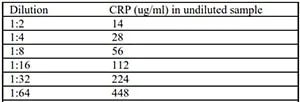 2. indicated in the following table 3. Then proceed for each dilution as in qualitative test.
 - The strength of the agglutination reaction is not indicative of the CRP concentration. Weak reactions may occur with slightly elevated or markedly elevated concentrations.
- A prozone phenomena (antigen excess) may cause false negatives. It is advisable, therefore, to check all negative sera by retesting at a 1:10 dilution.
- Reaction times longer than specified may produce apparent false reactions due to a drying effect.
- Strongly lipemic or contaminated sera can cause false positive reactions.
- Only serum should be used in this test.
- A quantitative titration procedure on positive specimens is required to observe increasing or
decreasing levels. - Patients with high titers of rheumatoid factors may give positive results.

Result Interpretation of CRP Test Positive:
Agglutination of latex particles, indicating the presence of C – reactive protein at a significant and detectable level.
Negative: No Agglutination.
For Semi-Quantitative Test Results, the last dilution of serum with visible agglutination is the CRP titre of the serum.
CALCULATION OF TITRE:
CRP ug/ml = 7 x D, where D is the highest dilution of serum showing agglutination and 7 is the sensitivity in ug/ml.



.webp)


0 Comments